 Agent Elmer
The question
How do you let a non-deterministic model help — without letting it decide?
Language models are brilliant and untrustworthy. They will write your software; they will also quietly invent a fact, a file, a number. For years we accepted that trade because there was no better one.
There is. Clamp the nondeterminism at the boundary — and make everything past that boundary a deterministic computation over pinned, content-addressed values.
The model proposes. Scripts dispose.
The move
Clamp the nondeterminism.
Nondeterminism is not forbidden — it is bounded. The model may propose; a strict schema, canonical bytes, and a content address decide whether the proposal becomes real. Everything downstream is reproducible: same inputs, same outcome, every time.
The first principle
Anything that can be made deterministic and verifiable — will be.
It is the same sentence we wrote a decade ago, in a different key: anything that can be incentivized will be incentivized. The ambition never changed. Only the mechanism became provable.
Where a concern can be mechanized, mechanizing it is mandatory. Where it cannot, the residue is isolated, recorded, and placed with a human — never hidden inside a model's confidence.
The shape
A component is a network; a network is a component.
There is no privileged level. A leaf is an atomic component. A network is a composite component that satisfies the same contract. The pipeline is a component. The runtime is a component. The agent is a component.
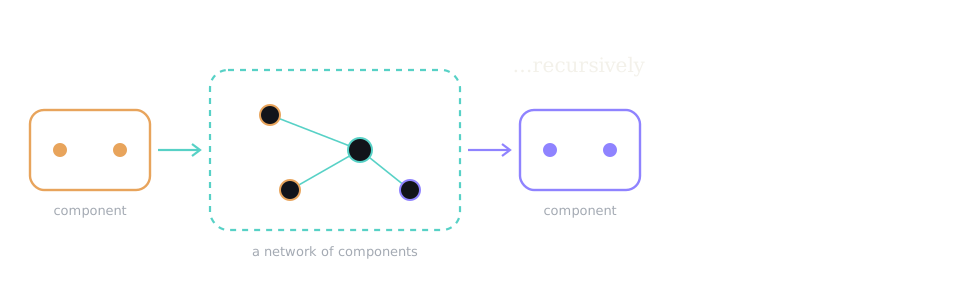
That self-similarity is not decoration. It is what lets one verification rule hold at every scale: if composition preserves determinism and verifiability, then the whole is exactly as provable as its parts.
Why agent-centric
Not one chain for the whole world.
In 2014, hearing about smart contracts, I opened the Bitcoin paper and stopped a couple of pages in — at the linked-list architecture. It was clever, and it was wrong, because it was data-centric: one global chain, one total order, agreed by everyone, forever.
I knew they had built it wrong — but I didn't want to rebuild it. Then, in 2018, I heard about Holochain and knew immediately: here was the right architecture for crypto and self-sovereignty — agent-centric, peer-to-peer, with no global singleton to centralise over time.
That is the world this work belongs to. We already had BitTorrent, git, and distributed hash tables; the agent-centric pattern is not exotic. Coordination belongs with the agent. Trust by reproduction, not by agreement.